Beyond Craft: The case for craftsmanship
Why craftsmanship matters more than ever in digital product design

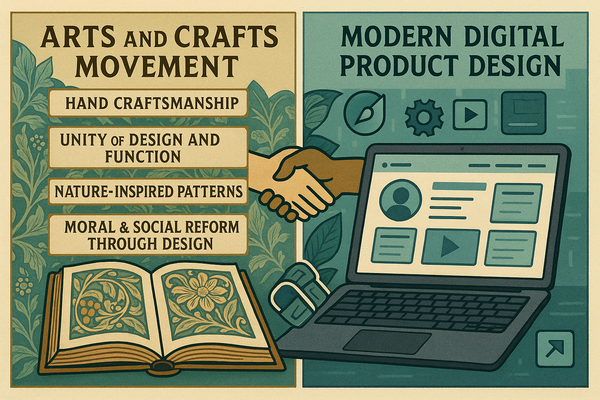
There is a word we reach for when we want to say something was made with care. That word is craft. In design circles, it has earned genuine respect — a hard-won corrective to the “just ship it” culture that has produced so many forgettable digital experiences. I’ve written about craft before about the mindset it requires and the historical movements that shaped its principles. But the more I sit with the idea, the more I find myself pressing on a distinction that rarely gets made explicit.
Craft and craftsmanship are not the same thing. Craft defines the work. Craftsmanship guides the worker.
Understanding the difference between them might be the most important question a designer can wrestle with right now — particularly as artificial intelligence begins to close the gap on what craft alone can produce.
Right vs Done
I didn’t arrive at design through a screen. I arrived through my hands.
In high school, I made leather goods — wallets, belts, and bags finished to a standard that had nothing to do with how long they took. I learned stitch spacing because uneven stitching was unacceptable to me. I learned to skive an edge so the fold would sit flat and to burnish until the leather took on a warmth that felt inherent. I was learning craft — the techniques of a material and its honest treatment.
But I was learning something else too, something I didn’t have a name for yet. I was learning what it felt like to care whether something was right, not just done. That distinction — done versus right — has followed me through every professional pursuit.
When I began making pottery in college, the material presented new challenges. Clay punishes dishonesty. A wall that is too thin will collapse. A foot ring that is poorly trimmed will tell on itself. The craft was new. But the practitioner’s standard — the insistence on going back to the wheel — that traveled with me without effort. It had already become part of who I was.
Decades later, the material changed again. The wheel became a screen. The clay became pixels and bytes. And once again, the craft had to be relearned. The standard didn’t.
There’s a Word For It
Western design culture has a vocabulary problem. We have craft. We have quality. We have mastery, which suggests a destination rather than a direction. None of these quite capture what I am trying to describe — the practitioner’s disposition, the daily commitment, the orientation toward the work that persists across materials and tools and decades.
There’s a word for it in Japanese: shokunin 職人.
It’s typically translated as “craftsperson” or “artisan,” but every translator notes the inadequacy of those equivalents. Shokunin carries a meaning that no single Western word fully holds — not merely skill, but a life-long devotion to continuous improvement in service of the person who will receive the work. It is less a job description than a philosophy of practice.
For westerners, Jiro Ono is probably the most familiar practitioner of Shokunin. He’s the sushi master documented in Jiro Dreams of Sushi. He has been making sushi for more than sixty years. He arrives before dawn. He still believes each piece could be better. The craft of sushi — the rice temperature, the knife angle, the particular pressure of each hand movement — is learnable. What Jiro embodies is something that cannot be transferred through instruction: the shokunin spirit is a choice made daily, renewed with each service, never declared complete.
Shoji Hamada — the great Japanese potter, National Living Treasure, and one of the central figures of the mingei folk craft movement — put it with characteristic economy:
“The right way lies in plainness and naturalness.”
Not brilliance. Not innovation. Plainness and naturalness. It is a statement about orientation, not technique. The shokunin does not reach for the spectacular. They reach. consistently and without fanfare, for what is right.
In the west Aristotle drew a related line between techne — craft knowledge, the know-how of making — and arete — excellence as a practitioner virtue, a disposition toward doing things well that shapes who you are over time. You can possess techne without arete. The Western tradition gave us the vocabulary. The shokunin tradition showed us what it looks like lived across a lifetime.
Shokunin and Design Practice
Three qualities of shokunin and have direct implications for how we think about design practice.
Discipline over inspiration. Mastery is built in the unglamorous repetitions, not the breakthrough moments. Jiro does not wait to feel inspired before he makes the rice. The skill lives in the daily practice, not the exceptional occasion. For designers, this is the discipline of iteration when the first solution feels good enough, the private standard that operates when no deadline is enforcing quality from the outside.
Service as the organizing principle. The shokunin’s work exists for the user receiving it, not the person making it. In digital product design, this maps directly to the commitment to the user’s experience over the designer’s ego or the product team’s feature list.
Perpetual incompleteness. A shokunin never declares arrival. There is no moment of graduation, no credential that certifies the pursuit as finished. This is what makes the concept feel alien to Western frameworks of mastery, which tend to frame skill acquisition as a ladder with a top rung. For the shokunin, the pursuit itself is the point.
Craftsmanship in Digital Product Design
Craft in digital design is concrete and teachable. It lives in:
- Typography that guides without announcing itself
- Microinteractions that communicate state with elegance and economy
- Component architecture that holds up when the system scales
- Accessibility decisions that treat every user’s experience as equally worth designing
- Animation that serves comprehension rather than decoration
These are learnable. They can be documented, systemized, and transferred. A talented junior designer can acquire them in a few years of serious practice. They are the techne of our discipline.
Craftsmanship is something different. It lives in a practitioner's behaviors that sustain and elevate craft over time — and that are often invisible to everyone except the designers themselves:
- Pushing back on a design decision that compromises the user, even when the meeting is running long and the deadline is real
- Returning to a shipped feature you know wasn’t right and fixing it, unprompted, without announcement
- Holding your personal standard during the private iterations that happen before the design is shared with anyone
- Mentoring a junior designer with the same rigor you apply to your own work
- Treating the user’s time and dignity as constraints that are simply not negotiable, regardless of what the product brief says
Craftsmanship in the AI Era
Two designers can produce pixel-identical screens. The difference between them only becomes visible in how they got there — and what they do when no one is watching. That invisible difference is craftsmanship.
Here is where the distinction becomes urgent rather than philosophical.
Artificial intelligence can replicate craft outputs with increasing fidelity. It can generate components, write interaction specifications, apply design tokens, produce layout variations at a scale and speed no human practitioner can match. The technical gap between AI-generated design and human-generated design is closing, and it will continue to close.
What AI cannot replicate is craftsmanship — because craftsmanship is not an output. It is an accountability. It is the practitioner’s willingness to stand behind the work, to care whether it is right, to go back when it isn’t. No model has a stake in the user’s experience. No model returns to a shipped feature because something was still nagging at it.
The risk for designers is not that AI replaces craft. The risk is subtler and more corrosive: designers who outsource to AI without having developed craftsmanship will produce work that is technically competent and experientially hollow, like a recipe without the cook.
The opportunity is its mirror image. Designers who bring genuine craftsmanship to AI-assisted work can direct it, evaluate it, and elevate it in ways that no prompt alone can produce. The shokunin spirit does not resist new tools — it holds them to the same standard as everything else. The question it asks of AI is the same question it asks of any material or method: does this serve the person at the other end of the experience? That question can only be asked by someone who has made the user’s dignity their organizing principle. AI cannot make that choice. The designer must.
This is where human-centered design finds its most durable defense — not in the argument that human hands produce better outputs than machines, but in the recognition that humans bring an irreplaceable orientation to the work. The craftsperson’s orientation. The shokunin’s orientation. A direction toward the person who will actually live inside the experience we build.
Craftsmanship is Never Finished
This is perhaps the hardest thing to accept about craftsmanship, and also the most liberating: you do not arrive. There is no credential, no portfolio milestone, no number of years in the discipline that certifies the pursuit as complete. The shokunin never declares mastery. The pursuit itself is the point.
For designers who want to cultivate craftsmanship rather than merely practice craft, a few things matter consistently:
Develop a design philosophy, not just a design aesthetic. An aesthetic is a preference. A philosophy is a considered position on what design is for, who it serves, and what you will and won’t sacrifice in its pursuit. The shokunin is guided by philosophy. The aesthetic follows from it.
Build honest critique practices. Give rigorous feedback and actively seek it. The practitioner who only receives praise is not getting the information they need to grow. Craftsmanship requires friction — the kind that comes from someone who cares enough about the work to tell you what isn’t right.
Revisit past work with honesty. Not for nostalgia, but for reckoning. Look at something you made two years ago and ask what you would do differently now. If the answer is nothing, you have stopped growing.
Find mentors and become one. Craftsmanship is inherently relational. It lives in the shokunin’s kitchen, in the design team that holds itself to a shared standard. The practitioner who develops in isolation develops incompletely.
Craftsmanship accrues. Every project either builds it or erodes it. There is no neutral. The standards you hold on the project nobody is watching are the standards you will carry into the project that everyone is.
The Practitioner Behind the Practice
Craft without craftsmanship is technically proficient but ultimately hollow. Craftsmanship without craft is aspiration without execution. The two must travel together, each making the other meaningful.
The leather I stitched in high school, the pottery I threw in college' and the interfaces I design today are made from entirely different materials. Each transition required learning the craft from nothing. But the practitioner’s standard — the private insistence on going back to the work, the refusal to call it done when it was merely finished, the organizing commitment to the person who would eventually hold or use or click through the thing — that did not require relearning. It had become structural. It was no longer something I applied to the work. It was something I brought to it.
That is the distinction craftsmanship makes. Not what you make, but who you become in the making of it.
The designers who will matter most in the next decade will not simply be those who produce excellent work. They will be those who have cultivated craftsmanship — the shokunin spirit, whatever material or tool or era they find themselves working in — and who bring that orientation to every decision, including the decision of what to ask of AI and what to insist on doing themselves.
Craft defines the work. Craftsmanship guides the worker.
We need both, but it is the worker who makes all the difference.
This article is the third in a series exploring craft in digital product design. Read the first, The Art of Craft in Digital Product Design, and the second, From Morris to Material Design.
This piece was developed in collaboration with AI and a human editor, with full editorial direction and ownership by the author